

Key Takeaways
- Diverse Tools: From apps to textbooks, there’s something for every learning style.
- Free and Paid Options: Not all quality resources cost money.
- Practice and Feedback: Interactive websites can improve your problem-solving.
- Community Support: Online forums and study groups offer quick help.
- Organization Matters: Keeping track of the best resources saves time and stress.
Want to get better at statistics but don’t know where to look for help? The good news is that you’re not alone—and there are tons of resources out there! From free websites and apps to textbooks packed with practice problems, you can find something that fits your unique learning style.
In this article, we’ll share 10 helpful resources for mastering statistics. We’ll talk about video tutorials that explain tough topics in fun ways, textbooks that walk you through step by step, and online forums where experts answer tricky questions.
Whether you’re a high school student preparing for an exam or a college student diving deeper into data analysis, these tools can make your journey smoother.
Let’s explore what’s out there and see which resources match your needs best.
Remember: Different learners need different approaches. One person might love a big workbook full of exercises, while another prefers quick videos. Experiment to see what helps you learn faster and enjoy the process.
Read also: Learn Statistics Step-by-Step: A Beginner’s Roadmap
1. Khan Academy
Why It’s Great:
- Free: No cost to sign up.
- Structured Lessons: Topics range from basic mean and median to more advanced subjects like regression.
- Video + Practice Combo: Watch a short video, then try a few related questions right away.
- Progress Tracking: You can create an account and see how many lessons you’ve completed.
How to Use It:
- Pick a Topic: Search “Statistics” to find specific lessons, like “descriptive statistics” or “probability.”
- Watch Videos: They’re usually under 10 minutes, making them easy to fit into a busy schedule.
- Do the Exercises: Reinforce what you learned by answering questions.
- Review Mistakes: If you get something wrong, the platform explains why.
Pro Tip: Start with the basics (mean, median, mode), then move up. Khan Academy lets you learn at your own pace. If you get stuck, you can replay the videos or pause them to take notes. It’s also a great resource if you’re studying for standardized tests or final exams.
2. Crash Course Statistics (YouTube Channel)
Why It’s Great:
- Entertaining Style: Hosted by engaging presenters who keep topics lively.
- Visual Explanations: Animated graphics help illustrate hard concepts.
- Free Access: All videos are on YouTube at no cost.
How to Use It:
- Search Specific Topics: Type “Crash Course Statistics correlation,” for example, to get a direct lesson.
- Take Notes: Jot down key points or formulas you see.
- Supplement with Practice: After watching, find exercises that align with the topic to solidify your understanding.
Pro Tip: Crash Course videos are fast-paced. You might need to pause or rewind to catch every detail. Consider watching with a friend or study group and pausing to discuss. This channel is especially good if you like a light-hearted approach to learning.
3. “Statistics for People Who (Think They) Hate Statistics” by Salkind & Frey
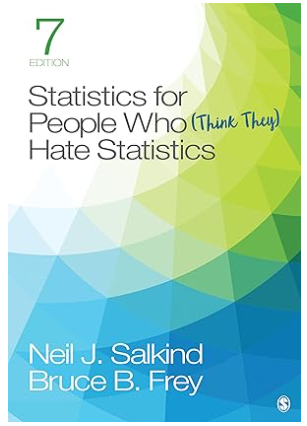
Why This Book?
- Beginner-Friendly: Uses everyday language to explain statistics concepts.
- Fun Examples: Helps ease math anxiety by relating stats to regular life scenarios.
- Workbook Style: Includes exercises at the end of chapters.
Highlights:
- Real-Life Scenarios: From figuring out how often you’re likely to hit a green light to analyzing music trends.
- Clear Chapter Breakdown: You can easily jump to sections on probability, t-tests, or correlation.
- Humor and Encouragement: Salkind’s tone helps reduce the fear factor many feel around math.
How to Use It:
- Start with the Table of Contents: Pick a chapter that corresponds to what you’re learning in class.
- Read Slowly and Take Notes: The book is written in an approachable style, but it’s still math—pace yourself.
- Do the Practice Problems: Practice is where the knowledge really sticks.
- Reflect on Examples: The author often ties concepts to everyday experiences; take a moment to connect those with your own life.
Pro Tip: If you’re struggling with a specific area (like standard deviation), you can skip straight to that section. This book doesn’t need to be read front-to-back; you can treat it as a reference guide. Many students find it a confidence booster because it demystifies statistics.
Check out the book by Salkind and Frey.
4. Quizlet and Anki (Flashcard Apps)
Why They’re Great:
- Memorize Key Terms: Flashcards are excellent for definitions and formulas (like “variance” or “z-score”).
- Portable Practice: Study on your phone or computer anytime.
- Spaced Repetition: These apps show you harder cards more often and easier ones less frequently.
How to Use Them:
- Create a Deck for Each Topic: For example, “Probability Terms” or “Regression Formulas.”
- Add Definitions and Examples: Don’t just write “variance = …”; add a quick example so it’s more memorable.
- Review Daily: A few minutes a day can help concepts stick.
- Explore Shared Decks: Many users upload their decks, so you might find one that matches your course.
Pro Tip: Use images or diagrams on your flashcards if you’re a visual learner. Also, try reading the formula out loud or explaining it in your own words to deepen understanding.
5. WolframAlpha (Online Computational Tool)
What Is It?
- Smart Calculator: Type in a question like “mean of 2, 5, 7, 10” or “standard deviation of these numbers,” and it calculates instantly.
- Step-by-Step Solutions: For many problems, it shows how it arrived at the answer.
- Broad Scope: Covers algebra, calculus, and statistics.
How to Use It:
- Check Your Homework: After you try a problem manually, see if WolframAlpha confirms your result.
- Learn Methods: If it offers a step-by-step breakdown, compare that method to yours.
- Explore Advanced Topics: You can also learn about distributions (normal, binomial, etc.) by typing “normal distribution with mean 0, sd 1.”
Caution:
Don’t rely on WolframAlpha to do all your work. Use it as a tool for confirmation and learning. If you just plug everything in without understanding, you might struggle on exams where you can’t use a computer.
6. Stack Exchange and Reddit Communities
Why They’re Helpful:
- Fast Answers: Post a question, and community members often reply within hours.
- Diverse Expertise: Some users are teachers, professors, or professionals in data analysis.
- Archived Solutions: Many common statistics questions have already been asked. Searching can reveal detailed explanations.
How to Use Them:
- Be Specific: If you just say, “I don’t get probability,” it’s too broad. Instead, ask something like, “How do I calculate the probability of drawing two red cards in a row from a standard deck?”
- Show Your Work: People are more willing to help if they see you tried.
- Follow Up: If someone gives an answer, reply or ask clarifying questions.
Popular Forums:
- Cross Validated (Stack Exchange for Statistics): Great for more technical or in-depth questions.
- r/learnmath or r/statistics (Reddit): Friendly communities that welcome beginners.
Pro Tip: Always check the rules of each forum. Some don’t allow posting entire homework questions without showing effort. Also, remember that any advice you get should be verified, especially if it’s for graded assignments. Still, these platforms can feel like having thousands of study buddies at your fingertips.
7. Datacamp and Coursera Courses
Why They’re Great:
- Structured Learning: Courses outline each topic clearly.
- Interactive Exercises: Many have hands-on coding tasks if you’re into data science or want to see real data sets.
- Certificates: Some paid courses offer certificates, which can be nice for college applications or resumes.
Datacamp:
- Focuses mostly on data science skills using programming languages like R or Python.
- Each short lesson includes quizzes and coding challenges.
Coursera:
- Partnered with universities.
- Offers both free and paid courses, some are self-paced, others have deadlines.
- Topics range from “Basic Statistics” to “Advanced Machine Learning.”
How to Use Them:
- Pick a Beginner Course: Especially if you’re not ready for coding, look for an introductory statistics course.
- Watch Lectures and Do Assignments: Work on practice sets to cement your understanding.
- Set a Schedule: Online courses require discipline. Plan weekly study blocks.
- Engage in Discussion Forums: Post questions or answer others’, which deepens your learning.
Pro Tip: Don’t feel pressured to complete a whole course if you only need help with one area (like probability). You can sign up, watch the relevant lectures, and practice that section alone. But if you aim to build a thorough understanding, following the entire course is beneficial.
8. Textbooks with Practice Problems
Aside from the Salkind book mentioned above, there are many other textbooks that focus on practice problems:
- “Schaum’s Outline of Probability and Statistics”: Known for tons of solved problems.
- “Elementary Statistics” by Mario F. Triola: A popular choice in many intro college courses.
Why They’re Helpful:
- Lots of Examples: Work through problems with step-by-step solutions.
- Practice Sections: End-of-chapter quizzes test your knowledge immediately.
- Clear Explanations: Often break down concepts in a structured, methodical way.
How to Use Textbooks Effectively:
- Skim the Chapter Summary: Before diving in, see the key points.
- Try Example Problems: Compare your process to the solution.
- Do Practice Sets: Mark questions you miss, then review those topics.
- Use the Index: Quickly look up a term (like “z-score”) to find where it’s explained.
Pro Tip: If a textbook problem confuses you, try searching the question online. Sometimes you’ll find a forum discussion or video explanation that clarifies the exact problem. Textbooks can be dense, so it’s okay to pair them with lighter resources like YouTube tutorials for extra support.
9. Local Study Groups and Tutoring
Why Face-to-Face Can Help:
- Instant Feedback: A tutor or study buddy can spot your mistake right away.
- Motivation Boost: Studying with others can keep you accountable.
- Customization: A tutor can tailor lessons to your exact needs.
How to Find Them:
- School or Community Boards: Many libraries or community centers have postings for study groups.
- Ask Teachers: They might recommend a school-based tutoring program or older students who excel in statistics.
- Check Local Listings: Websites like Wyzant or university tutoring boards.
How to Make It Work:
- Set Clear Goals: Are you focusing on a specific chapter or preparing for a big exam?
- Agree on a Schedule: Consistency (like meeting once a week) can lead to steady progress.
- Practice Between Sessions: Don’t rely solely on the tutor. Do solo study too.
Pro Tip: Even if you’re generally independent, a few targeted tutoring sessions can be a game-changer before a final exam. And for parents looking to support their children, a tutor can fill in gaps and build confidence without replacing your student’s own efforts.
10. Keeping Your Own Statistics Notebook
Why It’s Essential:
- Personalized Resource: It grows with you, storing definitions, formulas, and solved examples.
- Quick Reference: Save time by not flipping through entire textbooks each time you forget a formula.
- Deeper Learning: Writing things down helps your brain remember (Mueller & Oppenheimer, 2014).
How to Organize It
- Key Terms and Definitions: Dedicate a few pages to words like “mean,” “variance,” and “p-value.” Explain each in simple language.
- Formula Sheet: List crucial formulas with short explanations.
- Example Problems: Keep solutions to a few representative questions for each topic.
- Mistakes and Fixes: Whenever you make an error, write it down and note the correct approach. This keeps you from repeating the same mistake.
Digital vs. Paper
- Paper Notebook: Some students find handwriting more memorable. Plus, you can doodle or color-code formulas easily.
- Digital Notebook (like Google Docs or Evernote): Search functions make finding notes simple. You can also insert screenshots or links to helpful videos.
Maintenance
- Update Weekly: After you learn something new, add it right away.
- Review It Before Tests: Glance through all your main formulas and example problems.
- Cross-Reference: If you find a new resource (like a YouTube tutorial) that explains a topic better, add the link.
Pro Tip
Consider using colored pens or highlights. For instance, write formulas in blue, definitions in green, and examples in black. This visual structure can save time when you’re scanning your notes. Also, including personal observations—like “I struggled with standard deviation until I realized it’s just the square root of variance!”—makes the notebook feel more engaging.
Final Thought: No matter how many fancy online tools you use, a good notebook is often the best quick reference. It’s your personalized companion on the statistics journey, reflecting exactly how you learn and what you need to remember.
Conclusion: Resources for Studying Statistics
From easy-to-watch YouTube videos to in-depth textbooks, there’s a wealth of resources ready to help you master statistics. The trick is to find the ones that fit your learning style. Maybe you’re a visual learner who loves Crash Course videos, or maybe you excel with step-by-step exercises from a workbook. Some students enjoy group discussions on Reddit, while others thrive on one-on-one tutoring.
Remember, it’s okay to mix and match. Use multiple tools to cover all bases—watch a video to grasp a concept, then do practice problems in a textbook, then confirm your answers with WolframAlpha. Keep your statistics notebook updated with each new concept or formula you learn. That way, you’re building a personal resource library you can revisit anytime.
In the end, statistics is about understanding and applying data, not just memorizing formulas. Having diverse resources ensures you learn from different angles and truly “get” each topic. So explore these 10 resources, add them to your toolkit, and watch your confidence and skill in statistics grow every day.
References
Mueller, P. A., & Oppenheimer, D. M. (2014). The pen is mightier than the keyboard: Advantages of longhand over laptop note taking. Psychological Science, 25(6), 1159–1168.


